Begin…after…final for the future Sakura
It’s time for me to reflect on my learning journey. In order to facilitate my critical reflection, I will use Gibbs’ (1988) reflection cycle model. This can be divided into the following stages:
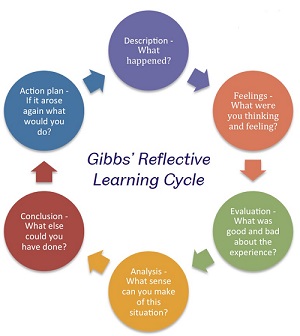
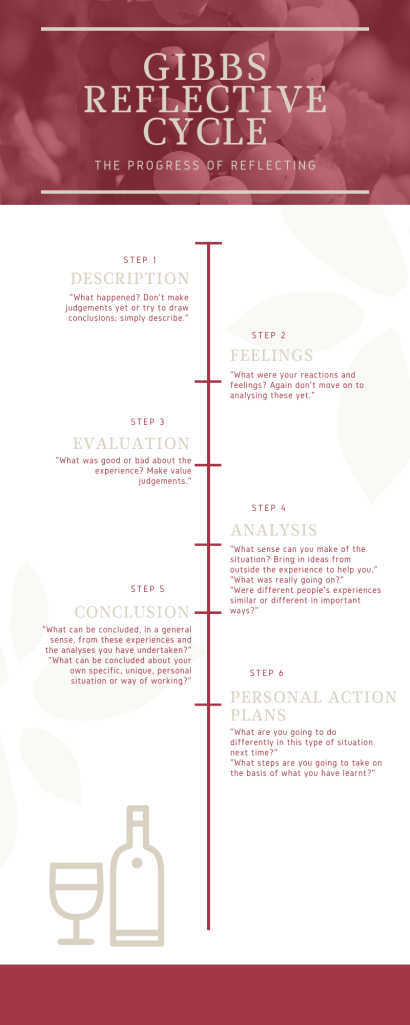
Description
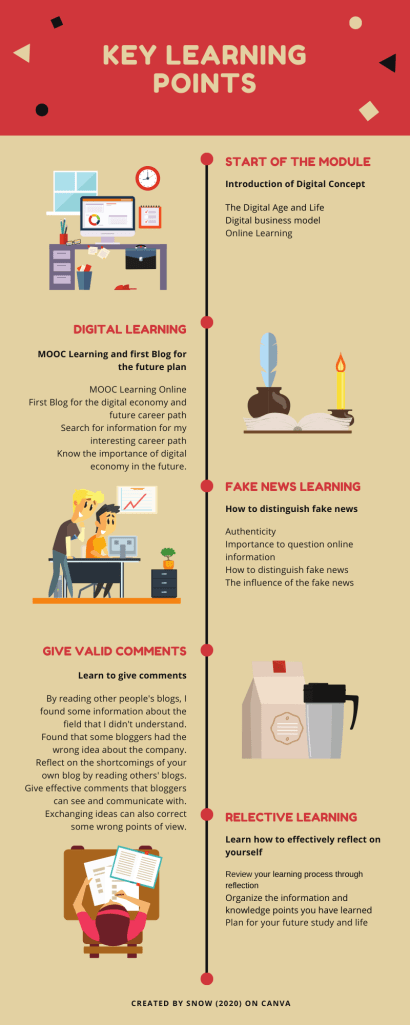
As shown above, in addition to this essential knowledge, I also improved my application of computer software and website. I can say that now I am proficient in computer software, whether it is writing a blog, making videos, or making posters, although I used to design brochures and posters for the company when I was an intern. I can do better work now than I did then. And through blog writing, I have gained a deeper understanding of the digital field of the company I want to work for in the future.
In addition to the skills I developed myself, learning from others is the key to this module:
As you can see, interactions occur continuously, and these are just a few examples. This was useful because although I focused on specific aspects of the topic (to accommodate the word limit), reading other people’s blogs and learning about various points of view on other aspects of the topic allowed me to study the topic in greater depth.
Feelings
I must admit, although I was excited because there were few classes, I was worried at first. I worried that my skills weren’t good enough for the module and that the curtailment of courses wouldn’t allow me to study the module in more detail. However, I overcame the difficulties through online help from my teachers and materials from MOOCs.
Besides, I am confused about how to learn through this unusual method. I now treasure the benefits I think it’s the best approach and it works for me. It is because the module is a continuous process — you not only learn something but also forget it and leave it. I am continually improving my skills without any exams/lectures. Consistency in deadlines helps with skill development. Practice, practice, practice! Although I used to be better at handling all kinds of computer software than my peers, I always used it for work. In this module, I used it for the first time to learn and plan my future. It made me realize the convenience of the digital age and the sense of accomplishment after finishing the work.
Also, I’m excited (being told you can do modules in bed, so I don’t think it will be too challenging). I was wrong: my time management skill was challenged!
Evaluation
Analysis
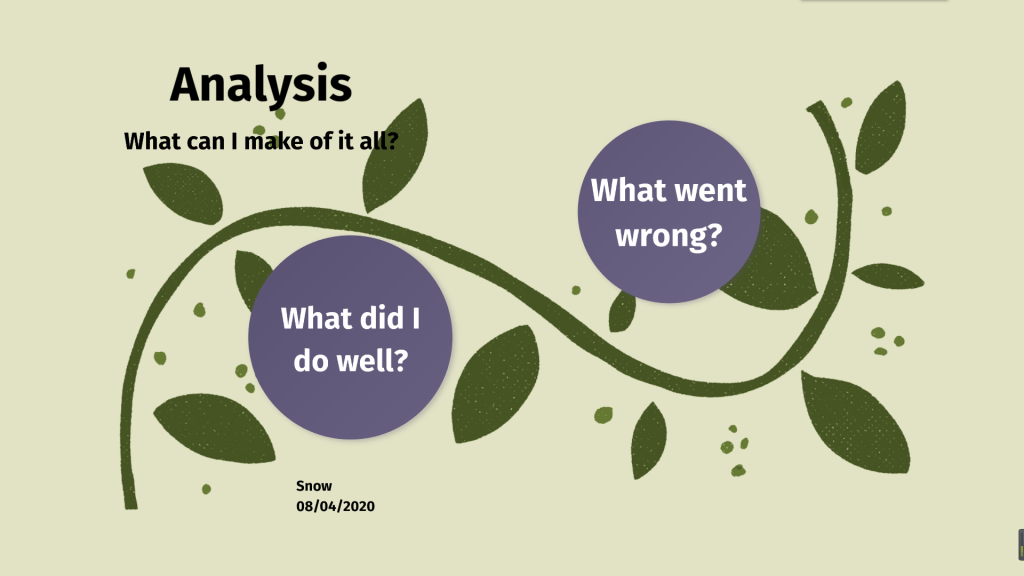
https://prezi.com/view/DNTO92Cffiu4nVPTtRzx/
Conclusion
Ultimately, my experience with this module has been enriching. One thing I might do differently is to pay more attention to the traffic to my blog. Few students comment on my blog, perhaps because my blog does not attract them, or my blog lacks specific characteristics. When I asked my classmates, most of them thought my blog was too professional and comprehensive. They couldn’t comment. I think my blog should be more exciting and remove some technical terms or convert them into simple words that are easy to understand.
Personal Action Plans
If I were given another chance to do this module or something similar, I would be bolder in content creation and increase communication with teachers. In terms of job hunting, to stay in the UK, I should improve my language skills to eliminate the exchange barrier with natives. I plan to get my first job at a game company, so I need to develop further my use of various media software and commercial software.
Reference List
Gibbs, G. (1988). Learning by doing: A guide to teaching and learning methods. Oxford: Further Education Unit, Oxford Polytechnic.
 Snow
Snow 